
Ecotrons
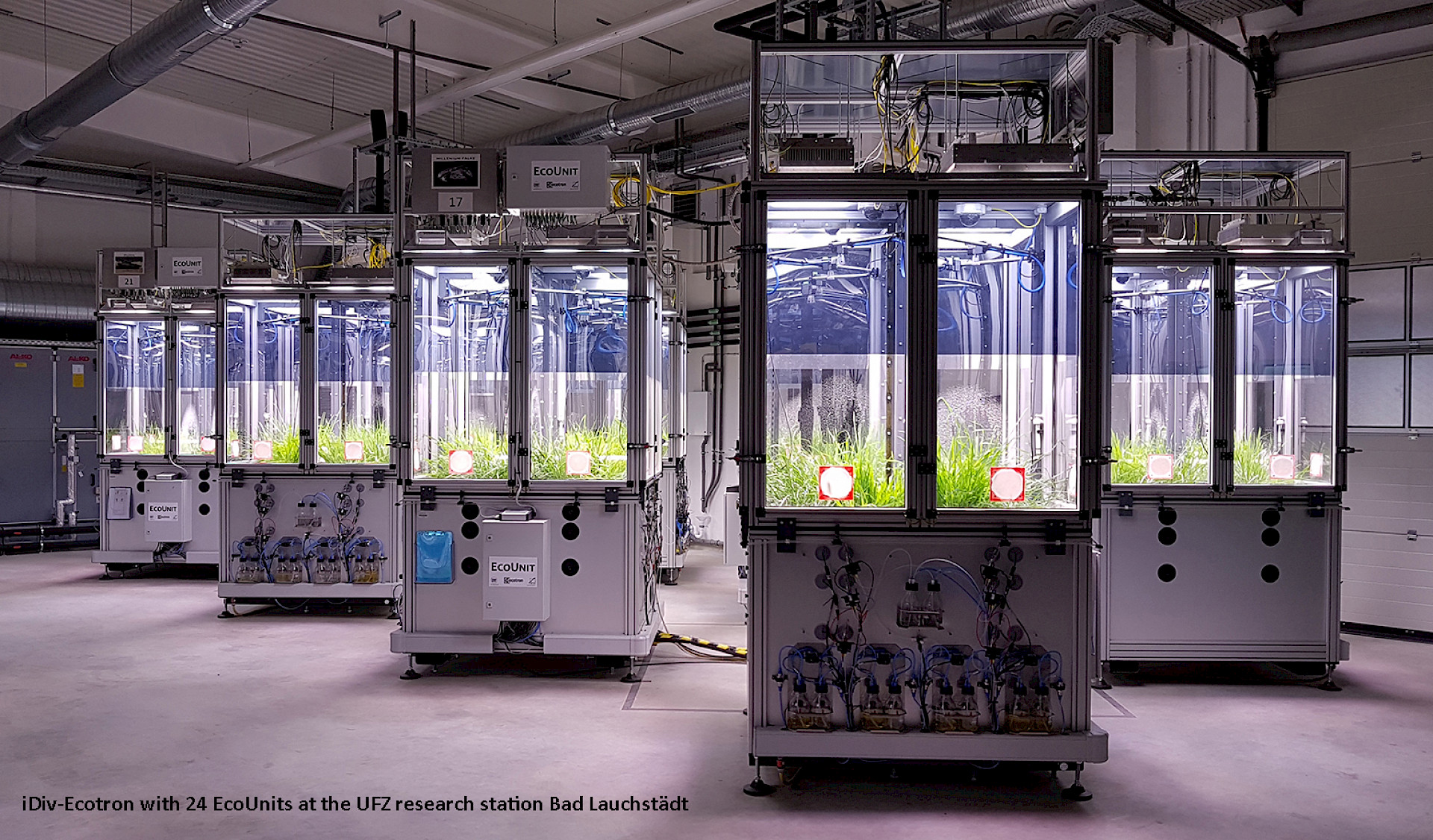
Ecotrons are lysimeter applications that go beyond the observation of soil processes. With these measuring devices, we bring your entire ecosystem into the laboratory. These mini-ecosystems and climate chambers enable the comprehensive investigation of ecosystem functions in the pedos-, bio-, atmospheric continuum under controlled boundary conditions. Our systems are variable and can be optimized for your research objective.
Our products
Ecotron Projects Video
Our Ecotrons
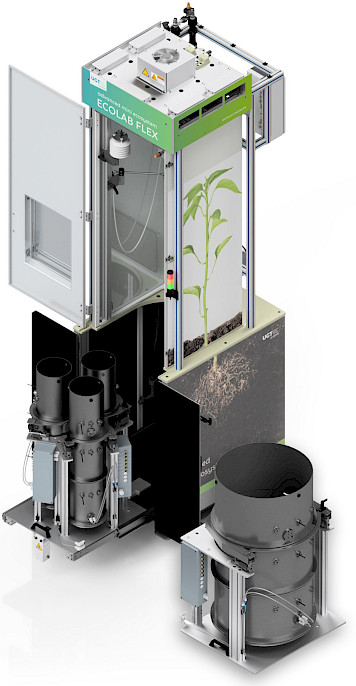
An Ecotron consists of two main components that are mounted vertically on top of each other:
Top: Atmospheric unit
The atmospheric unit simulates the above-ground habitat of flora and fauna. The atmospheric boundary conditions and parameters can be controlled and monitored with the help of measuring devices for recording temperature, humidity and gases as well as lighting, irrigation and ventilation systems.
Below: Soil unit with lysimeter
The soil unit of an Ecotron is used to investigate the biological, chemical and physical processes in the soil and their interactions with the flora and fauna of the soil. It is equipped with one or more lysimeter vessels on precision weighing systems and can contain a wide range of measurement and control technology, such as soil sensors (temperature, soil moisture, tension, redox electrode and Ag/AgCI reference electrode, water isotope probes WIPs), temperature regulation and tension control, groundwater level tubes or additional sensor feed-through and soil sampling ports.
Further development of the EcoLab flex
Based on the EcoUnit, which was developed and built by us for the iDiv Ecotron research facility, our Ecotron product range has been extended by the EcoLab flex. In contrast to the EcoUnit, precise control of humidity and temperature in the floor and atmosphere units is possible via a climate control unit. The EcoLab flex can also be equipped with a gas-tight hood that enables the sampling of gases.
Frequently Asked Questions - FAQ
Soil-Plant-Atmosphere Continuum (SPAC)
The Soil-Plant-Atmosphere Continuum (SPAC) describes the continuous transport of water from the soil through the plant and into the atmosphere:
Soil → Root → Plant → Atmosphere
Water flow is driven by differences in water potential along this system. Soil moisture, soil water potential (soil water tension), root water uptake, water transport within the plant, and transpiration are closely interrelated and collectively influence the water balance of an ecosystem.
A lysimeter is a scientific instrument used to investigate the soil water balance under near-natural conditions. It enables the quantitative measurement of precipitation (both falling and settled), evapotranspiration, seepage water, and solute transport within the soil. Modern weighing lysimeters provide highly accurate data on water and solute fluxes and are widely used in soil hydrology, climate research, agriculture, and environmental monitoring.
Climate change strongly affects water transport between soil, vegetation, and the atmosphere. The SPAC concept helps researchers understand drought stress, vegetation responses, and water availability while improving predictions of future ecosystem behaviour.
Contact us
Are you looking for a strong partner and a sustainable cooperation? Then simply get in touch with us! We love exciting and challenging projects around environmental technology.
 +49 33432 7559-0
 info@ugt-online.de